

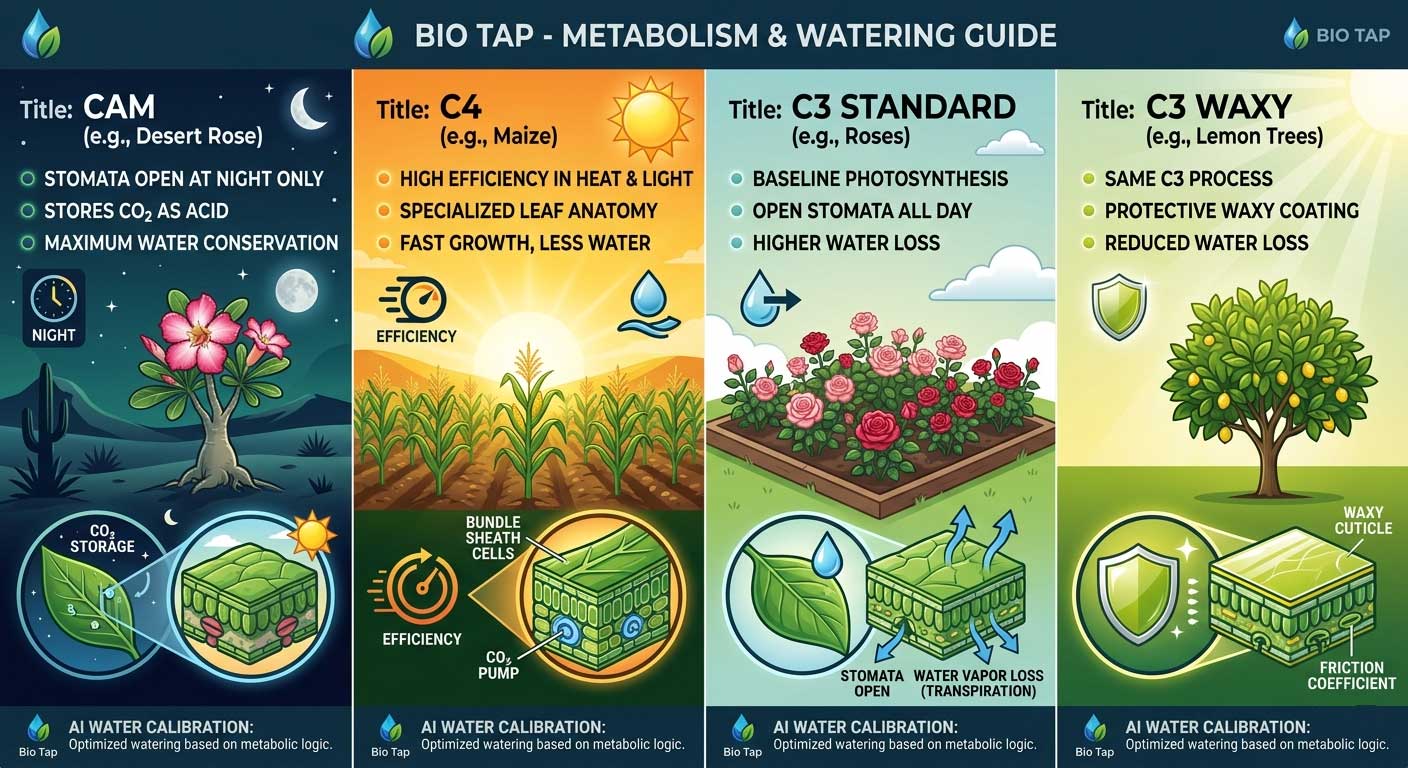
Not all plants “breathe” the same way. While every plant uses photosynthesis to turn sunlight into energy, the internal machinery they use to process carbon dioxide ($CO_2$) and water varies drastically. For the modern gardener or tech-driven agriculturist, understanding these four categories is the key to mastering water conservation.
1. C3 Standard: The Baseline (e.g., Roses)
Most plants on Earth (about 85%) are C3 plants. A classic example is the Rose. They are called “C3” because the first stable compound formed during photosynthesis contains three carbon atoms.
-
The Process: They open their stomata (pores) during the day to take in $CO_2$.
-
The Vulnerability: Because their pores are open while the sun is out, they lose a significant amount of water through evaporation—a process known as transpiration.
-
Best For: Environments where water is relatively stable; otherwise, they wilt quickly in the midday heat.
2. C3 Waxy: The Armored Variant (e.g., Lemon Trees)
Physiologically, these are still C3 plants, but they have developed a physical “shield.” Take the Lemon Tree (and many citrus varieties) as an example; they possess thick, glossy leaves.
-
The Advantage: This “waxy” cuticle increases the Friction Coefficient of the leaf surface. It creates a physical barrier that slows down water loss even when the stomata are open.
-
The Result: They are more resilient than standard roses in windy or high-heat environments, requiring a different watering logic despite following the C3 pathway.
3. C4: The High-Efficiency Turbo (e.g., Maize)
C4 plants, like Maize (Corn) and many tropical grasses, are the high-performance engines of the plant world. They have evolved a specialized internal anatomy to thrive in intense heat without “choking” on oxygen.
-
The Process: They physically move $CO_2$ into specialized “bundle sheath” cells. This concentrates the carbon, allowing the plant to photosynthesize faster and keep its stomata partially closed.
-
The Advantage: They are incredibly efficient. They can produce more growth with less water than a C3 plant in the same blistering sun.
4. CAM: The Night Owls (e.g., Desert Rose / Adenium)
CAM (Crassulacean Acid Metabolism) is the ultimate water-saving strategy, perfectly exemplified by the Desert Rose. These are the survivalists of the plant kingdom.
-
The Process: The Desert Rose does the unthinkable: it keeps its stomata shut tight during the heat of the day. It only opens them at night when it is cool and humid to “collect” $CO_2$, which it stores as an acid until the sun comes up.
-
The Advantage: This nearly eliminates daytime water loss. It is a sophisticated form of biological water recovery that allows them to bloom in arid conditions.
Why Categorization Matters
By identifying a plant as CAM, C4, C3 Standard, or C3 Waxy, we move away from “guessing” how much water a plant needs. Instead, we use Algorithm-Driven Calibration.
Each category provides a specific logic block for a plant’s metabolism. When the AI identifies the plant—whether it’s the thirsty Rose or the night-breathing Desert Rose—it applies these metabolic rules to calculate the exact water requirement. This ensures the gardener provides precisely what is needed—not a drop more, not a drop less.
