

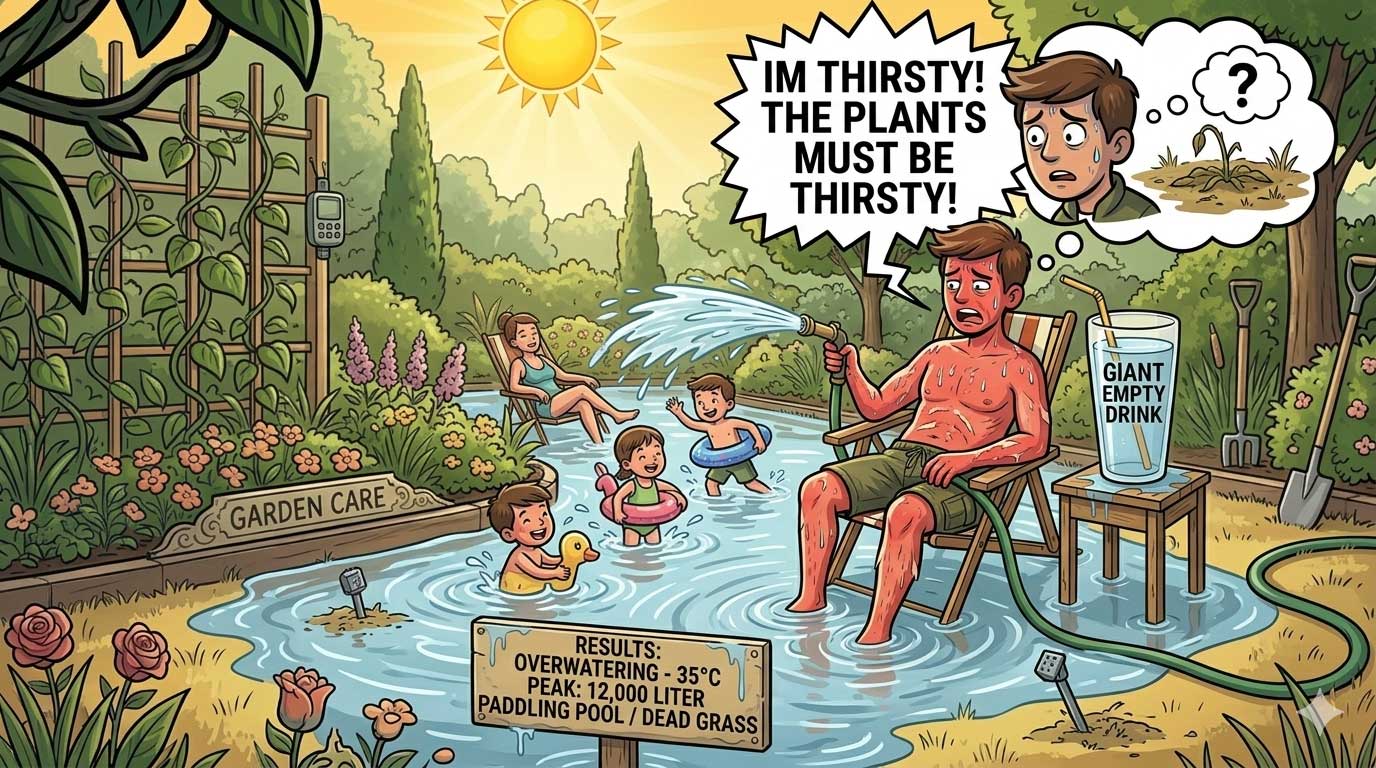
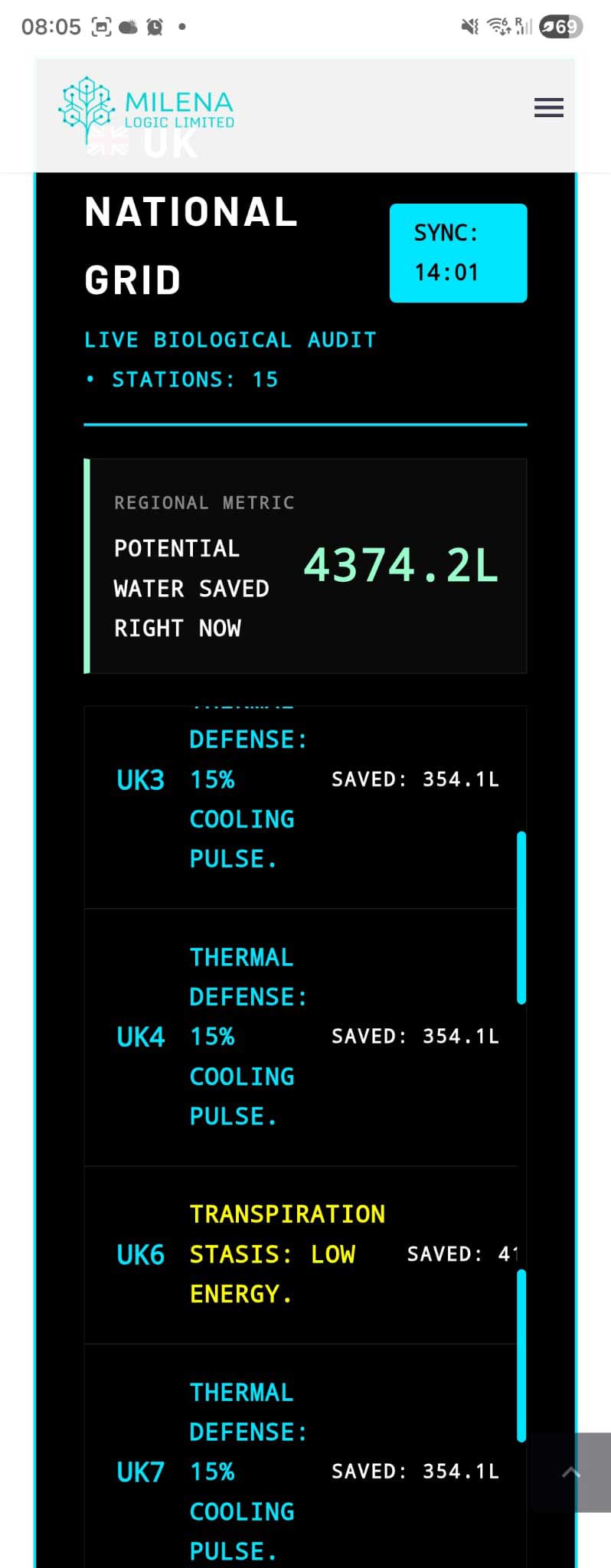
MAY 25, 2026, UK – As temperatures hit a record-breaking 35°C—the hottest May day in British history—the common assumption was that our lawns needed massive amounts of water to survive. But the data from the Milena Logic grid tells a different story. While humans sweated, our grass deployed 460 million years of evolutionary survival skills.
THE BIOLOGICAL TRUTH: GRASS DOESN’T “DRINK” LIKE WE DO
We often anthropomorphize our gardens, assuming that if we are thirsty, our plants are too. This is a myth. When temperatures soar, grass doesn’t just want water; it needs to manage its internal hydrostatic pressure. When the heat hit 35°C, our grid showed the plants entering a sophisticated, two-phase survival strategy that rendered traditional heavy watering not just unnecessary, but counter-productive.
-
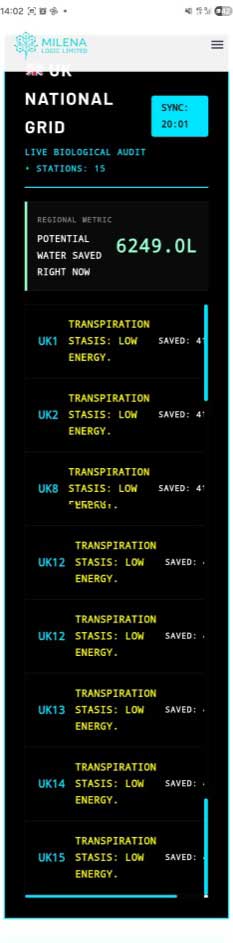
Phase I: The Cooling Pulse (Mid-Day Peak): As the mercury rose, our system delivered a targeted “15% Cooling Pulse.” This was not for irrigation, but for thermal management—mimicking dew to cool the leaf surface without saturating the soil.
-
Phase II: Transpiration Stasis (The Maritime Shift): As high humidity moved inland off the sea, the plants naturally stopped “drinking.” They entered Transpiration Stasis to conserve their metabolic energy. Forcing water onto grass in this state would have been a waste, creating a humid, oxygen-deprived soil environment—a recipe for fungal disaster.
THE NUMBERS THAT MATTER: 50m² OF SAVINGS
By respecting this 460-million-year-old adaptive process, our system managed a 50m² patch of grass with minimal intervention.
-
Traditional Approach: Would have required ~1,270 liters per week, regardless of the plant’s metabolic state.
-
The Milena Logic Grid: By matching supply to the plant’s actual survival state, we achieved a 30% reduction in water input—saving roughly 381 liters per week per patch—without a single blade of grass suffering heat stress.
NATIONAL IMPACT: THE SCALE OF EFFICIENCY
If just 10% of Britain’s 20.6 million domestic gardens adopted this metabolic-based approach, the impact would be historic:
-
Daily Savings: ~858 million liters of water.
-
Weekly Savings: ~6 billion liters of water—relieving massive strain on the national water grid during extreme weather events.
