

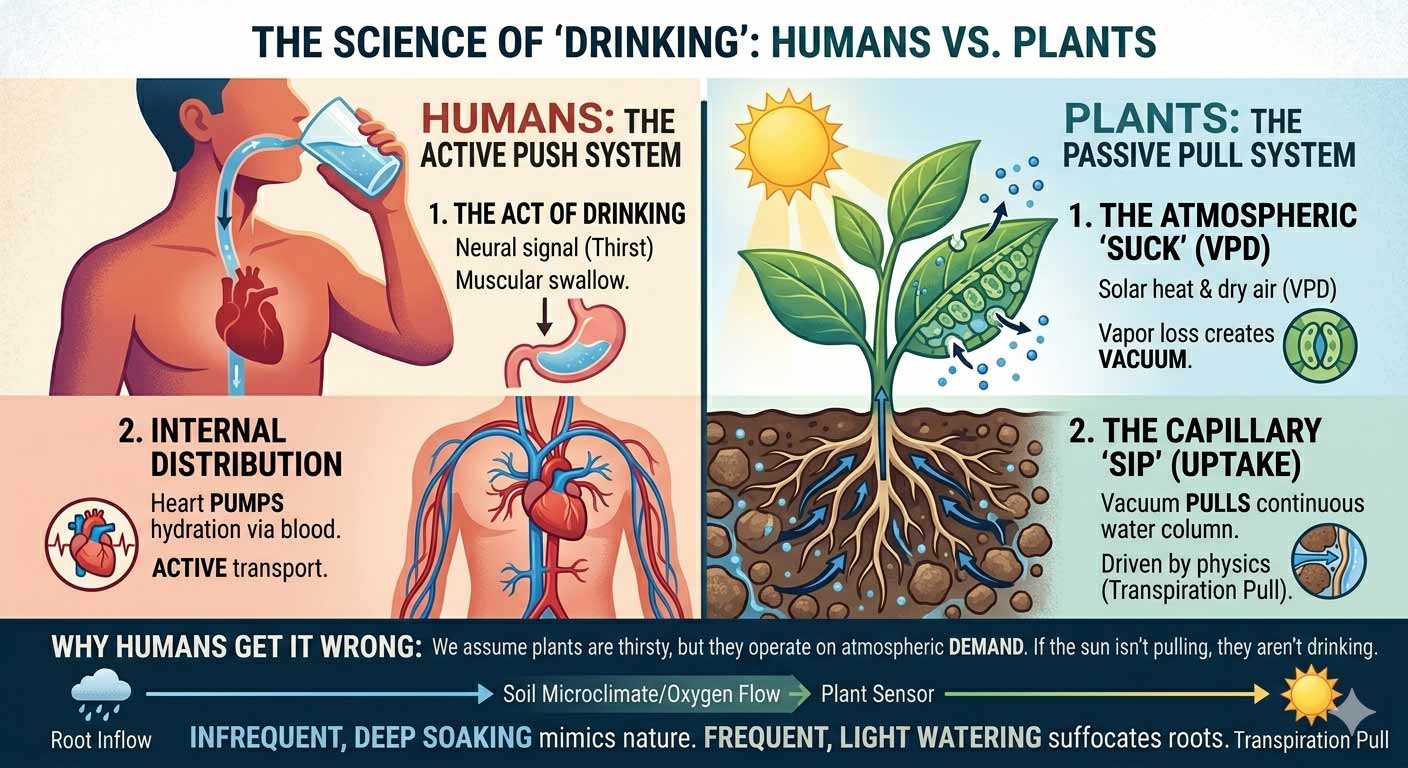
The fundamental difference between how humans and plants “drink” lies in the biological mechanics of transport and the triggers that signal thirst. Humans often get watering wrong because we tend to project our own biological needs onto organisms that operate on physics rather than impulse.
1. The Mechanic: Pull vs. Push
Humans drink through a “push” and “swallow” mechanism. We use muscles to create a vacuum and then move liquid into our digestive system. Once inside, our circulatory system “pushes” hydration to our cells using the heart.
Plants, however, operate on a “pull” mechanism called Transpiration.
-
-
The Solar Pump: As water evaporates from the leaves (through tiny pores called stomata), it creates a negative pressure.
-
Cohesion and Adhesion: Because water molecules stick together, this evaporation literally pulls a continuous “rope” of water up from the roots through the xylem.
-
The Difference: If a human stops drinking, we dehydrate but our “pump” (the heart) keeps working for a while. If a plant’s water column snaps (an embolism) due to extreme dryness, it can lose the physical ability to “pull” water entirely.
-
2. Why Humans Get Watering Wrong
The primary reason humans struggle with watering is Anthropomorphism—the tendency to treat plants like people.
The “Mealtime” Fallacy
Humans eat and drink on a schedule (breakfast, lunch, dinner). We assume plants need a “cup of water” every morning. In reality, a plant’s “thirst” is dictated by the Vapor Pressure Deficit (VPD)—the difference between the moisture in the leaf and the moisture in the air. On a humid, cloudy day, a plant may not “drink” at all because no water is evaporating from its leaves. Adding water then just drowns the roots.
The Drowning (Lack of Oxygen)
Humans breathe through lungs; plants “breathe” through their roots as well.
-
Soil Structure: Soil isn’t just dirt; it’s a network of “macropores” (air pockets).
-
The Error: When humans overwater, they fill every air pocket with water. Without oxygen, the roots cannot perform cellular respiration. They essentially suffocate, rot, and die. Paradoxically, a plant with root rot wilts because its dead roots can no longer “pull” water, leading the human to add even more water.
The Surface Bias
Humans tend to water the surface because that’s what we see. However, most functional “feeder roots” are deeper down. Light, frequent watering encourages shallow root systems that are vulnerable to heat. A heavy, infrequent “soaking” mimics natural rain cycles and encourages deep, resilient roots.
3. Key Comparisons at a Glance
| Feature | Humans | Plants |
| Primary Driver | Thirst (Neural signal) | Transpiration (Physical pull) |
| Transport System | Active (Heart/Muscles) | Passive (Physics/Capillary action) |
| Excess Management | Excretion (Kidneys) | Guttation (Oozing from leaves) |
| Root/Intake Health | Stomach/Intestines | Soil Microbiome & Mycorrhizae |
Summary
To water effectively, one must stop thinking like a “provider” and start thinking like a “sensor.” Instead of asking “Is it time to water?”, the question should be “Is the physics of the soil-plant-atmosphere continuum requesting more moisture?”
