

The UK Humidity Trap: Why Your Plants Do Not Need To Drink Even When It’s Dry
In the UK, we are a nation of weather-watchers. We see a break in the clouds between April and October and our first instinct is to grab the watering can. We assume that if the sun is out, the plants must be thirsty.
But there is a silent metabolic “stall” that happens in British gardens that most people completely miss. Because we live on a large island, our air is frequently heavy with moisture. This high humidity changes everything about how—and if—a plant drinks.
1. The 40% Rule: The Stalled Metabolism
Between mid-April and mid-October, the average relative humidity in the UK rarely drops below 70% to 75%. On many days, it sits at 80% or higher.
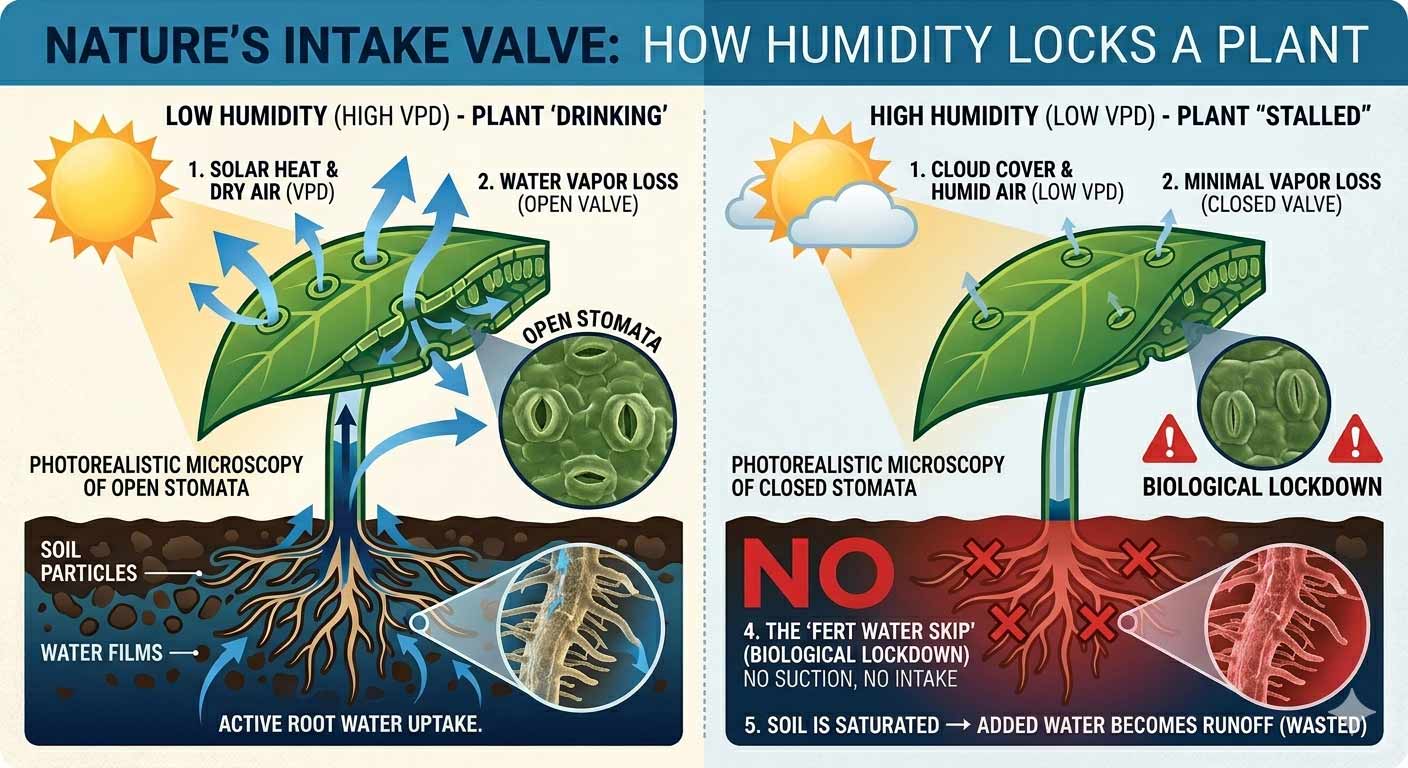
This is the “Stall Zone.” Plants don’t drink because they want to; they drink because the atmosphere “sucks” water out of their leaves (a process called Transpiration). When the humidity is high, the air is already “full” of water. The suction stops. The plant’s internal pump shuts down.
The Reality: On roughly 60 to 80 days of the UK growing season—nearly 40% of the time—your plants are effectively not drinking at all, regardless of whether it’s “watering day” on your calendar.
2. The Great Water Run-Off
When a gardener waters a plant that has “stalled” due to high humidity, two things happen, and neither of them is good:
-
The Soil Saturates: The soil hits its “Field Capacity” (the maximum water it can hold).
-
The Waste: Because the plant’s “intake valve” is closed by the humidity, it doesn’t draw from that soil reservoir. Every extra drop of water you pour simply runs off into the subsoil or leaches away essential nutrients.
Most of the time, you aren’t “saving” a plant; you are simply paying for water to move from your tap into the deep earth, bypassed entirely by the plant. In extreme cases, this standing water sits around the roots, cutting off oxygen and inviting rot.
3. The Micro-Climate Detection
The UK garden is a patchwork of invisible “Micro-Climates.” To find real water savings, we have to look closer than the regional weather forecast:
-
The Humidity Bubble: Areas shielded by fences or dense hedges trap moist air. Even on a warm day, the humidity in these “bubbles” stays high, meaning these plants need significantly less water than those in the open.
-
The Thermal Radiator: A south-facing brick wall or a stone patio acts as a heater. It lowers the local humidity by warming the air, creating the only spot in the garden where the “Solar Pump” is actually working at full tilt.
4. Turning Logic into Growth
The goal of modern gardening shouldn’t be to recreate water, but to stop wasting it when the plant’s metabolism says “No.”
By understanding the Vapor Pressure Deficit (VPD)—the actual “pulling power” of your specific garden’s air—you can identify those 80 days a year where you should simply walk away from the tap.
The Protocol: We must stop watering the “region” and start watering the Metabolism. When the humidity is high, the “Fert Water Skip” isn’t just a technical choice—it’s a biological necessity.
